

ASHRAE July 2026 Discussion Puts Daily Ventilation Performance Back in Focus
POPULA fan ventilation commissioning is becoming a more relevant discussion for factory and commercial-building teams that need to confirm how systems perform in everyday operation. In its July 2026 Journal, ASHRAE highlighted a practical gap: a testing, adjusting and balancing report taken at maximum design conditions does not automatically prove that a building receives the required outside-air flow during ordinary part-load operation. For facilities that rely on exhaust fans, make-up air and ducted ventilation, the message is straightforward—verify the real airflow path, not only the equipment nameplate.
That distinction matters in active industrial buildings. Production schedules change, doors open and close, filters load, dampers drift, temporary partitions appear and fan operating modes are adjusted to reduce noise or energy use. A system that once appeared balanced can gradually deliver less effective air exchange to the zones where heat, odor, dust or occupied workstations create the greatest demand. The result may be hot or stuffy areas, uneven pressure, short-circuit airflow or complaints that are difficult to explain from a drawing alone.
POPULA recommends treating commissioning as a field-based check of fan operation, air entry and air exit conditions. A POPULA fan ventilation commissioning review can start with the building layout, fan locations, duct routes, louvers, electrical control logic and the site’s normal operating schedule. It is not a substitute for the project engineer, local code requirements or industrial-hygiene measurements; it is a practical way to make fan selection and layout decisions more accountable to real conditions.
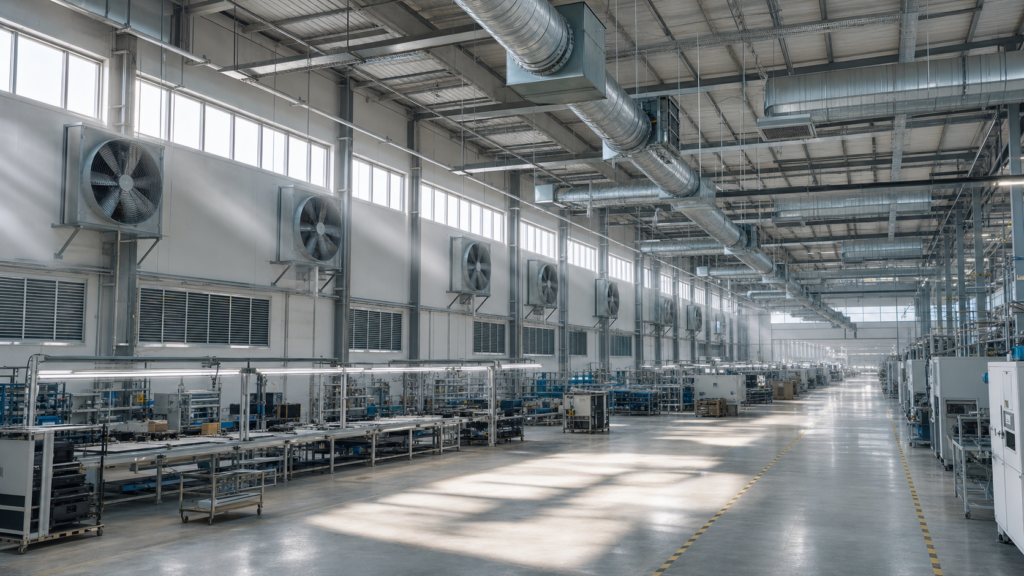
POPULA fan ventilation commissioning for factories and commercial facilities
Commissioning should be planned around how the facility actually operates, rather than only around peak-load calculations. Teams can compare intended airflow with observations at normal production levels: which exhaust fans run, which make-up air paths are open, where doors or louvers affect pressure, and whether air reaches the occupied or process zones that need it. Where measurements are required, qualified professionals should use suitable instruments and follow the applicable project, safety and regulatory requirements.
Fan type still matters. Axial fans are often suitable for high-volume wall or roof exhaust where system resistance is relatively low. Centrifugal fans are more appropriate where ductwork, filtration or process capture creates higher static pressure. In either case, a correct model can still underperform if it is installed into a blocked intake path, an unsuitable duct route or a control sequence that does not match the building’s daily occupancy and process conditions.
A useful site record includes fan model and rotation direction, rated airflow and pressure, visible inlet and discharge restrictions, damper positions, filter condition, vibration or noise observations, operating hours and basic temperature or airflow observations by zone. This information creates a clearer basis for deciding whether to clean, repair, rebalance, reposition or replace equipment. It also helps prevent a common mistake: increasing fan size before confirming why the original airflow route is not working.
From test report to dependable daily airflow
The July ASHRAE discussion is especially relevant to buildings that spend much of the year at partial load. Outside-air delivery and exhaust performance can change when variable-speed drives reduce fan speed, control dampers modulate, or different areas of a facility are occupied at different times. Facility teams should therefore review ventilation during representative operating periods, not only at handover or during an idealized full-load test.
For industrial ventilation projects, the objective is a stable and understandable airflow path: air can enter the building where needed, travel through the work or process zone, and leave through correctly selected and maintained exhaust points. When contamination capture is required, local exhaust and enclosure design should be addressed by qualified specialists rather than relying on general air movement alone. Make-up air is equally important, because insufficient replacement air can reduce exhaust performance and create unwanted negative pressure.
POPULA supports customers with fan selection, application discussion and layout-oriented product recommendations for general ventilation and ducted airflow projects. By considering operating conditions, system resistance, installation space, maintenance access and control needs together, a POPULA fan plan can better support the commissioning work that follows. The strongest result is not simply a fan that runs, but a ventilation system whose daily performance can be checked, understood and maintained over time.