

يدفع التخطيط لمواجهة الإجهاد الحراري لعام 2026 المصانع إلى إعادة فحص أنظمة التهوية الصناعية.
POPULA fan heat stress ventilation is becoming a practical planning topic as the 2026 summer production season advances. Factory managers, EHS teams and facility engineers are paying closer attention to indoor temperature, humidity, rest planning and engineering controls. In the United States, OSHA’s heat injury and illness prevention rulemaking for indoor and outdoor workplaces has also kept attention on workplace heat risk. Even in regions where the final legal requirement may differ, the operational message is clear: factories cannot treat hot indoor air as only a comfort issue.
For industrial buildings, the first line of improvement is often not a single fan purchase, but a full review of airflow. Workshops with heat-generating machines, curing lines, ovens, welding zones, compressors or dense production layouts can develop pockets of stagnant air. When these areas are not exhausted properly, workers feel heat stress earlier and equipment may also run in a less stable environment. This is why many plants are now checking whether their existing exhaust fans, fresh-air inlets and circulation paths are still suitable for today’s production load.
شعبية sees this trend across manufacturing customers that want practical ventilation upgrades without overcomplicating the system. A POPULA fan solution for heat stress ventilation is usually based on airflow direction, installation position, pressure loss, noise expectation and maintenance access. The goal is not simply to add more air movement, but to move hot air out, bring usable fresh air in and reduce dead zones around production operators.
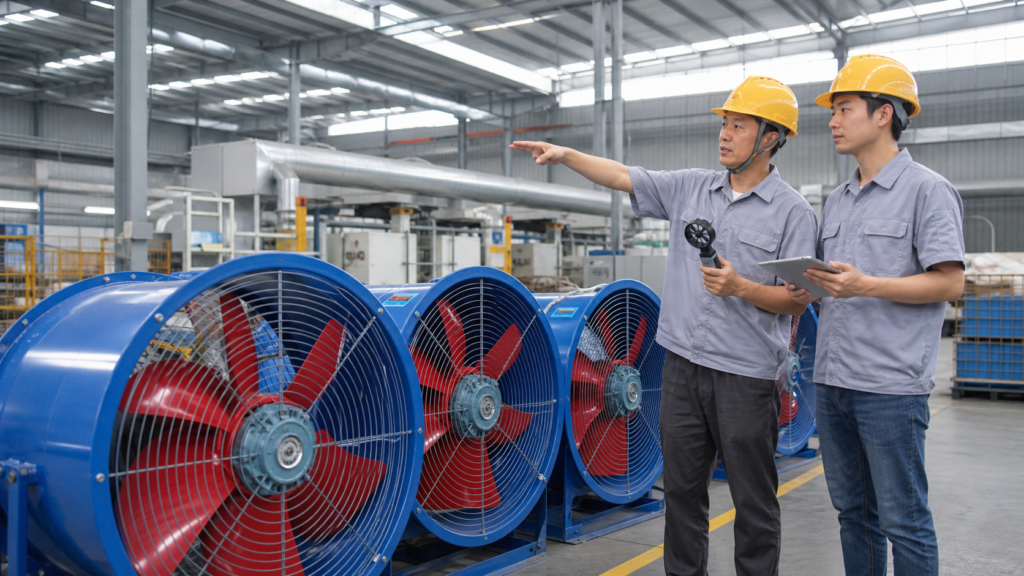
Why POPULA fan heat stress ventilation is becoming a purchasing factor
In many factories, summer ventilation used to be handled reactively: add portable fans, open doors, or increase exhaust operation during the hottest weeks. That approach may still help in small areas, but it is less reliable for larger workshops or production lines with strict process requirements. Once a plant has multiple heat sources, long shifts or limited natural ventilation, facility teams need a more engineered answer.
A heat-stress ventilation review normally starts with several basic questions. Where is heat generated? Where does hot air accumulate? Are roof or wall exhaust points positioned to remove the hottest air? Can fresh air reach worker zones before it is pulled directly out? Are the fans running continuously, intermittently or only when the workshop becomes uncomfortable? These questions influence whether an industrial axial fan, centrifugal exhaust fan, roof fan or mixed system is more suitable.
For POPULA fan selection, the important point is matching equipment to the site instead of copying a generic specification. Axial ventilation fans can be useful where large airflow and relatively low resistance are needed, such as wall exhaust, roof exhaust or general workshop air exchange. Centrifugal fans may be more suitable when duct resistance, filtration, smoke extraction or process exhaust pressure is higher. If the application involves high temperature, smoke, grease, dust or corrosive gas, the fan structure, motor position and material choices must be reviewed carefully.
What factories should check before ordering new fans
Before ordering new ventilation equipment, POPULA recommends that factories collect several site details: workshop dimensions, heat source locations, current fan capacity, inlet and outlet positions, operating hours, duct layout, expected air changes, installation height and available power supply. Photos and short videos are also useful because they show whether airflow is blocked by platforms, storage racks, production lines or building columns.
The second step is to decide the purpose of each fan. Some fans are responsible for removing hot air from the upper area of the workshop. Others are used to push fresh air toward operator stations or support cross ventilation. In more demanding projects, fans may work together with ducts, louvers, dampers or control panels. Clear roles help avoid a common mistake: installing powerful fans that move air locally but do not improve the overall ventilation path.
For 2026 procurement, the most reliable approach is to combine safety thinking with energy awareness. Oversized fans may waste electricity and create unnecessary noise; undersized fans may fail to reduce heat build-up during peak production. POPULA fan engineers can help customers compare airflow, pressure, motor power, installation method and maintenance needs so the final industrial ventilation fan system is easier to operate through the full hot season.
As heat-stress planning becomes a stronger part of factory management, POPULA fan heat stress ventilation will continue to move from emergency response to planned infrastructure. For manufacturers in hot climates or enclosed workshops, reviewing the airflow system early can make summer production more stable, more comfortable and more predictable.