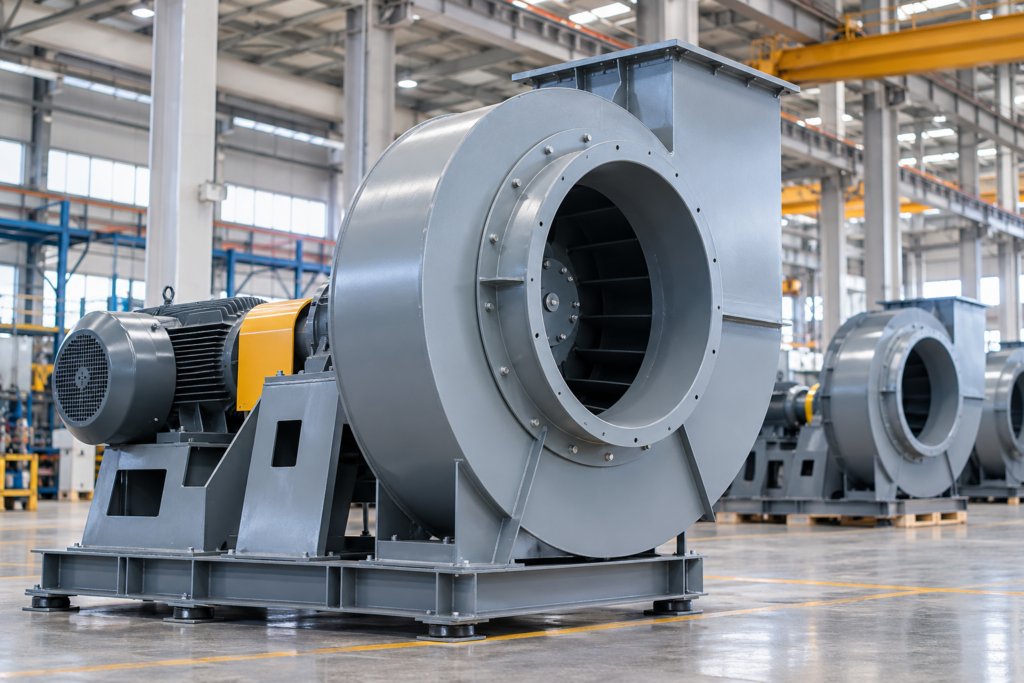

4-72 Centrifugal Fan: Applications, Features and Selection Guide
の 4-72 centrifugal fan is a widely used industrial ventilation fan designed for moving air and other compatible gases in factories, workshops, and building ventilation systems. Its centrifugal impeller and volute housing make it suitable for applications requiring controlled airflow through ducts and exhaust equipment.
For industrial buyers, choosing the right 4-72 centrifugal fan involves more than comparing motor power or fan size. Airflow, pressure, operating temperature, installation conditions, and system resistance all influence the final selection.
This guide from POPULA FAN explains how the 4-72 centrifugal fan works, where it is commonly used, and what to consider before purchasing one.
What Is a 4-72 Centrifugal Fan?
A 4-72 centrifugal fan is a general-purpose centrifugal ventilation fan commonly used to transport clean air and other compatible, non-corrosive gases under appropriate operating conditions.
The fan uses a rotating impeller to draw air into its inlet. The air is accelerated through the impeller and discharged through the volute casing toward the outlet.
Compared with many general-purpose axial fans, a centrifugal fan can be more suitable for ventilation systems that require airflow to overcome resistance from ductwork, bends, dampers, and other components.
The 4-72 series is commonly considered for industrial and commercial ventilation projects where reliable air movement is required.
How Does a 4-72 Centrifugal Fan Work?
The operation of a 4-72 centrifugal fan involves several important components.
1. Air Inlet
Air enters the fan through the inlet, which guides the airflow toward the rotating impeller.
The inlet configuration and surrounding ductwork can affect the airflow entering the fan.
2. Centrifugal Impeller
The impeller is the main rotating component responsible for transferring mechanical energy to the air.
As the impeller rotates, air moves outward through the blade passages, increasing its energy.
3. Volute Housing
The spiral-shaped housing collects airflow discharged from the impeller and directs it toward the outlet.
Its geometry helps manage airflow and pressure conversion within the fan.
4. Motor and Drive System
The motor supplies the mechanical power required to rotate the impeller.
Depending on the specific fan configuration, the drive arrangement may involve direct coupling, belt transmission, or another manufacturer-approved design.
5. Fan Outlet
Air exits through the outlet and enters the connected ventilation system.
Proper outlet connections and duct design help minimize unnecessary system losses.
Main Applications of the 4-72 Centrifugal Fan
The 4-72 series is used in a variety of general ventilation applications.
Factory and Workshop Ventilation
Manufacturing facilities often require ventilation to remove warm air, maintain air circulation, and support a suitable working environment.
A 4-72 centrifugal fan can be considered for compatible factory exhaust or air supply systems, especially when ductwork creates pressure resistance.
倉庫の換気
Warehouses may require mechanical ventilation to improve air exchange and reduce heat accumulation.
Where airflow must travel through ducts or other system components, a centrifugal fan may offer an appropriate solution.
Industrial Exhaust Systems
Industrial exhaust systems use fans to transport air from extraction points to discharge locations.
The 4-72 series may be suitable for systems handling clean air or compatible gases within the fan’s specified operating limits.
HVAC and Building Ventilation
Centrifugal fans are commonly used in building ventilation systems because they can deliver airflow against duct resistance.
A 4-72 fan may be evaluated for appropriate air-handling or exhaust applications.
Equipment and Process Ventilation
Some industrial equipment requires controlled air supply or exhaust.
A 4-72 centrifugal fan can be considered where the airflow, pressure, temperature, and gas characteristics match the selected model’s specifications.
Key Factors When Selecting a 4-72 Centrifugal Fan
Selecting a centrifugal fan requires understanding the complete ventilation system rather than focusing only on the fan itself.
Required Airflow
Airflow is the volume of air the fan must deliver within a given period.
It is commonly expressed in cubic meters per hour (m³/h) or cubic feet per minute (CFM).
The required airflow depends on the ventilation purpose, system design, and operating conditions.
A fan with insufficient airflow may not meet ventilation requirements, while an oversized fan can create unnecessary energy consumption.
Static Pressure and System Resistance
The fan must overcome resistance created by ducts, bends, dampers, and other components.
Before selecting a 4-72 centrifugal fan, determine the system pressure requirement at the desired airflow.
The actual operating point is established by the interaction between the fan performance curve and the system resistance curve.
Operating Temperature
The temperature of the conveyed air or gas affects fan selection.
A standard general-purpose fan should not automatically be used for high-temperature applications.
Always confirm the permitted operating temperature for the exact fan configuration.
Gas and Dust Characteristics
The 4-72 series is generally associated with clean-air and compatible-gas ventilation.
Applications involving heavy dust loading, corrosive gases, combustible dust, or other hazardous media may require specialized equipment and additional safety measures.
Motor Power and Electrical Requirements
Motor power should be selected according to the required operating point and manufacturer performance data.
Industrial buyers should also confirm voltage, frequency, motor rating, and applicable electrical requirements.
Installation Space
Review the available installation space, inlet and outlet direction, mounting arrangement, and maintenance access.
Correct installation helps reduce vibration, airflow losses, and unnecessary operating problems.
4-72 Centrifugal Fan vs High-Pressure Centrifugal Fan
A common purchasing question is whether a general-purpose 4-72 centrifugal fan or a high-pressure centrifugal fan is more appropriate.
The answer depends on the ventilation system.
| Selection Factor | 4-72 遠心ファン | High-Pressure Centrifugal Fan |
|---|---|---|
| Typical purpose | General ventilation and exhaust | Higher-pressure industrial air movement |
| System resistance | Suitable within its rated performance range | Designed for applications requiring greater pressure capability |
| Common applications | Factory ventilation, duct exhaust, building air handling | Process air supply, pressure-demanding duct systems |
| Model selection | Based on airflow and pressure curves | Based on airflow, pressure, and operating conditions |
POPULA FAN offers general-purpose centrifugal fans as well as high-pressure centrifugal fan series, including 9-19 and 9-26 models.
Buyers should compare performance curves for the actual operating point instead of assuming that a high-pressure fan is always the better choice.
How to Improve the Efficiency of a 4-72 Centrifugal Fan System
Fan efficiency depends on both equipment design and the ventilation system.
Several measures can help improve overall performance.
Choose the correct operating point. Select a fan that delivers the required airflow and pressure within an appropriate operating range.
Reduce unnecessary duct resistance. Avoid poorly designed duct transitions, excessive elbows, and avoidable obstructions.
Maintain the impeller. Dust accumulation and damage can affect impeller balance and airflow performance.
Inspect bearings and drive components. Regular maintenance helps identify developing mechanical problems.
Consider suitable speed control. Where airflow demand varies, appropriately designed variable-speed operation may reduce energy consumption.
Actual savings depend on the system characteristics and operating schedule.
Common Mistakes When Buying a 4-72 Centrifugal Fan
Selecting by Motor Power Alone
A motor rating does not directly tell buyers how much airflow a fan will deliver at a particular pressure.
Always review the fan performance data.
Ignoring Duct Resistance
A fan may provide a high free-air flow rate but deliver less airflow after being connected to a restrictive duct system.
Using the Wrong Fan for Dust or Corrosive Gas
General-purpose centrifugal fans should not automatically be selected for abrasive dust, corrosive media, or hazardous atmospheres.
Ignoring Installation Requirements
Insufficient maintenance clearance, poor duct connections, or unsuitable mounting can create operating difficulties.
Comparing Prices Without Comparing Performance
Two fans with similar motor ratings may have different performance curves, construction details, and operating requirements.
A useful quotation comparison should include airflow, pressure, motor specifications, materials, and applicable operating conditions.
POPULA FAN 4-72 Centrifugal Fan Solutions
POPULA FAN supplies industrial centrifugal fans and axial fans for a range of ventilation applications.
The company’s product range includes the 4-72 centrifugal fan series for general-purpose ventilation, along with other centrifugal fan models for different pressure and operating requirements.
For industrial buyers, the appropriate fan should be selected according to the required airflow, system pressure, operating environment, and installation conditions.
When evaluating a POPULA FAN 4-72 centrifugal fan, buyers can provide their technical requirements to discuss suitable configurations and obtain relevant product specifications.
Frequently Asked Questions About 4-72 Centrifugal Fans
What is a 4-72 centrifugal fan used for?
The 4-72 series is commonly used for general industrial ventilation, factory exhaust, building ventilation, and compatible ducted air-handling applications.
Is a 4-72 centrifugal fan suitable for dust collection?
It is primarily associated with general ventilation. Applications involving significant dust loading may require a specialized dust extraction fan, depending on the material and operating conditions.
How do I choose the correct 4-72 fan size?
Determine the required airflow and system pressure, then compare the manufacturer’s performance curves for suitable fan sizes and operating speeds.
Can a 4-72 centrifugal fan operate continuously?
Continuous-duty suitability depends on the exact model, motor rating, operating conditions, and manufacturer’s specifications.
What information is needed for a quotation?
Provide airflow, pressure, temperature, gas characteristics, voltage, frequency, installation requirements, and expected operating schedule.
Conclusion
The 4-72 centrifugal fan is a practical option for many general industrial ventilation and air-handling applications.
However, successful fan selection requires matching the equipment to the actual airflow and pressure requirements of the system.
By reviewing performance curves, operating conditions, and installation requirements, buyers can make more informed purchasing decisions and avoid common ventilation problems.
Request a 4-72 Centrifugal Fan Quotation
Looking for a centrifugal fan for factory ventilation, workshop exhaust, or a ducted air-handling system?
Contact POPULA FAN with your required airflow, pressure, operating temperature, and electrical specifications to discuss suitable industrial fan options.
Website: https://www.chinapopula.com/