

POPULAファンのエネルギー効率監査が産業用換気における優先事項に
POPULA fan energy efficiency audit is becoming a more important topic for industrial facilities as factories review how much electricity is used by ventilation, cooling and air movement systems. The 2026 edition of the Statistical Review of World Energy, published by the Energy Institute, highlighted another year of strong global energy demand in 2025. For manufacturers, that pressure turns energy management from a finance-only issue into a practical engineering question: are the fans moving the right air, in the right direction, for the right operating hours?
Industrial ventilation fans are often installed early in a building’s life and then kept running for many years while production lines, storage layouts and heat sources change around them. A system that was reasonable five years ago may now be oversized, blocked by new equipment, or operating without a clear airflow path. In many workshops, fans run continuously because nobody wants to risk heat, odor or dust accumulation, but continuous operation does not always mean efficient ventilation.
ポピュラ sees more customers asking for practical ways to check fan performance before ordering new equipment. A POPULA fan energy efficiency audit does not start by assuming every fan must be replaced. It starts by comparing actual site conditions with airflow requirements, motor power, fan position, duct resistance, operating schedule and maintenance condition. This gives factory teams a clearer basis for upgrading, relocating or optimizing industrial ventilation fans.
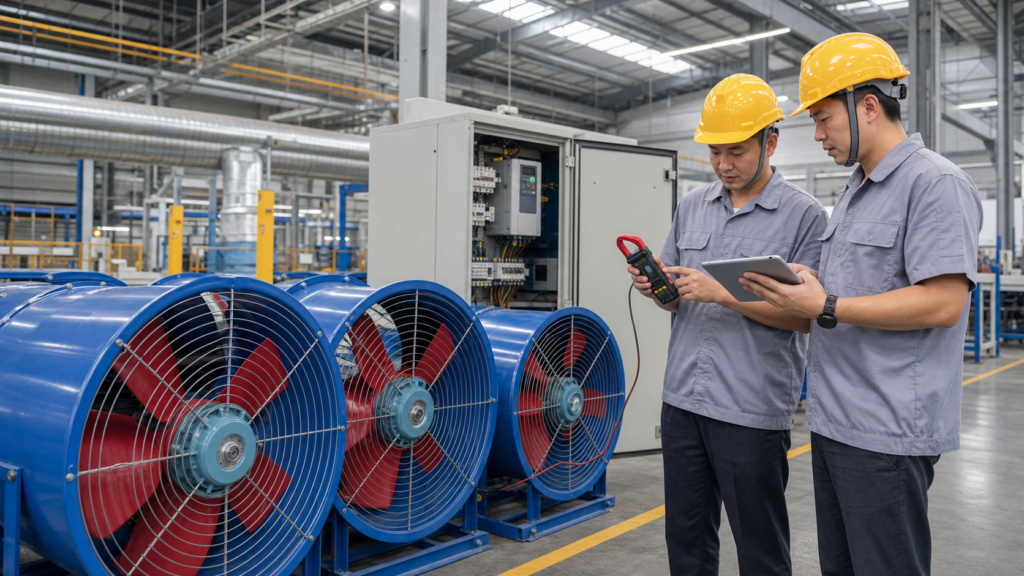
POPULA fan energy efficiency audit for changing factory demand
Energy pressure is not the only reason factories are reviewing ventilation systems. Many plants are also dealing with hotter production seasons, denser equipment layouts, new environmental expectations and higher expectations for worker comfort. These changes make the ventilation system work harder than before. When the system is not reviewed, the result can be a familiar mix of high electricity use, uneven airflow and limited improvement in the areas that actually need ventilation.
A useful audit usually begins with simple but disciplined questions. Which fans are running every day? Which fans are connected to ducts, filters, dampers or louvers? Where are heat, fumes or moisture produced? Are fresh-air paths clear, or is incoming air short-circuiting directly to an exhaust point? Are fans controlled by production schedule, temperature, pressure, or only by manual habit? These questions help identify whether the main issue is product selection, layout, control strategy or maintenance.
For POPULA fan projects, the product choice depends on the application. Axial fans can be suitable for large airflow with relatively low resistance, such as general workshop exhaust, wall ventilation or warehouse air exchange. Centrifugal fans are often more appropriate where duct pressure, filtration, smoke extraction or process exhaust resistance is higher. Roof fans, fire smoke exhaust fans and specialized industrial fans should also be selected according to the real operating environment instead of a single airflow number.
What factories should check before replacing ventilation fans
Replacing a fan without checking the system can create a new problem. A larger fan may increase noise, overload the duct path or waste power if the air route is blocked. A smaller fan may reduce electricity use on paper but fail to remove heat or contaminants during peak operation. POPULA recommends reviewing airflow direction, inlet and outlet area, duct resistance, motor condition, blade cleanliness, bearing condition, electrical control and the actual time that each fan needs to run.
The audit should also consider operating modes. Some factories need stable continuous ventilation because the process produces heat or odor all day. Others can benefit from zone control, scheduled operation or variable operation when production changes by shift. Even a basic control improvement can reduce unnecessary running time if it is matched to the site. The key is to avoid turning off ventilation blindly; energy saving must still support safe and effective air exchange.
As energy costs and efficiency expectations remain important in 2026, POPULA expects more industrial customers to treat fan systems as part of facility optimization rather than isolated equipment. A careful POPULA fan energy efficiency audit can help factories decide whether to clean, repair, relocate, control or replace existing fans. For new projects, the same thinking helps customers select POPULA fan models that fit the real airflow path, installation condition and long-term maintenance needs.