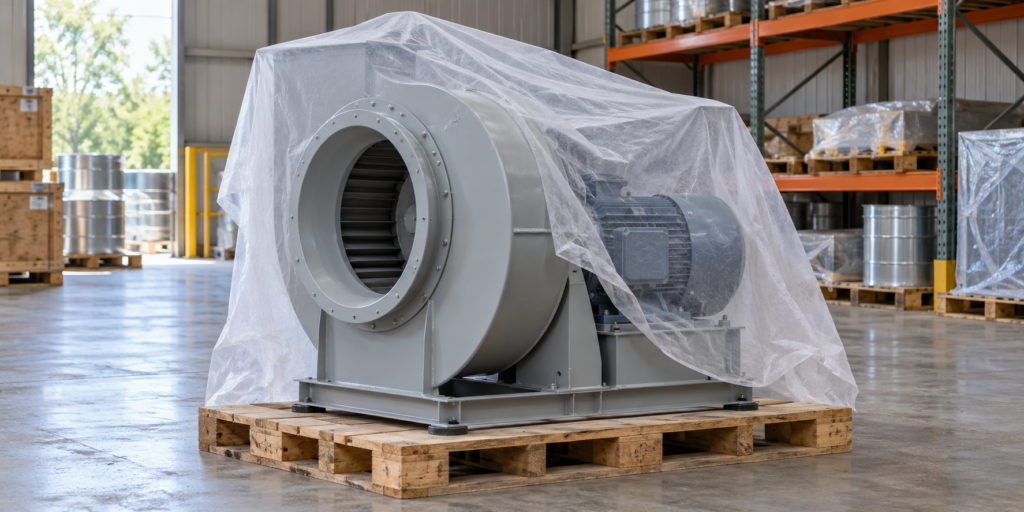

How to Store an Industrial Fan Before Installation: A Practical Checklist
Industrial fan storage before installation is easier to manage when teams follow the exact model manual. Industrial fans are not always installed as soon as they arrive. A project schedule, building work or a delayed shutdown can leave equipment in storage for weeks or months. A few basic precautions can help protect the fan while it waits, but the product-specific installation and maintenance manual must take priority over general advice.
This checklist applies broadly to centrifugal and axial fans. Storage periods, bearing arrangements, coatings and motor requirements differ by model, so confirm the instructions supplied with the equipment before taking action.
1. Choose a dry, stable storage location
Keep the fan in a clean, covered area where rain, standing water, direct weather exposure and construction debris cannot reach it. Avoid locations exposed to persistent vibration from nearby machinery; external vibration can damage bearings while equipment is stationary. If indoor storage is not possible, use a protected arrangement approved by the manufacturer and inspect it more frequently.
Keep the unit in the shipping or storage orientation specified by the manufacturer. Support it at its designated base or shipping supports. Do not place loads on the shaft, impeller, motor, inlet cone or other components, and do not stack items on the fan unless the packing instructions explicitly allow it.
2. Protect openings, surfaces and components
Keep inlet and discharge openings covered against dust, loose material and moisture. Use a cover that protects the fan without trapping condensation against the equipment. Do not seal a damp fan inside plastic. Check the cover after temperature or weather changes and replace it if it is torn, wet or holding water.
Protect machined surfaces and exposed shafts from corrosion using only the method approved by the equipment or motor manufacturer. Keep the protective packaging and labels in place where they do not hold moisture or obstruct required inspection. Do not apply coatings, solvents or preservatives to bearings, belts, electrical enclosures or other parts unless the relevant manual permits them.
3. Follow the manual for bearings and motors
Storage maintenance depends on the bearing and drive arrangement. Some manufacturer instructions call for periodic shaft rotation or bearing lubrication during extended storage; the interval and procedure are model-specific. Follow the fan and motor manuals, record each required check, and contact the supplier if the storage period exceeds the manual’s guidance. Do not assume that every fan needs the same lubrication or rotation schedule.
Keep motors and electrical components dry. Any inspection, insulation check or electrical work should be carried out by a qualified person using the motor manufacturer’s instructions and applicable site procedures. Isolate equipment before inspection and never energize a fan while it is covered or otherwise obstructed.
4. Preserve identification and handling information
Keep the nameplate, serial number, packing list and installation documents with the fan or in a clearly identified project file. Retain any shipping braces or restraints until the manual says they should be removed. When the unit must be moved, use only the lifting points and method stated in its instructions; do not lift by the motor, shaft, guard or casing opening unless those parts are identified as lifting points.
A simple storage log can record the delivery date, storage location, condition on arrival, cover checks, any manufacturer-required bearing actions and the date of the final pre-installation inspection. This creates a clear handover between receiving, warehouse and installation teams.
5. Inspect the fan before installation
Before moving the fan to its final position, compare its identification and configuration with the approved order and installation documents. Look for impact damage, corrosion, water entry, loose parts or signs that packaging has shifted. If damage or contamination is found, photograph it and ask the supplier or a qualified service technician for direction before installation.
Once the equipment is safely accessible and isolated, carry out only the checks allowed by the product manual. For example, some fan manuals call for checking that the wheel turns freely and that no parts rub; do not force a wheel or remove guards to perform a check unless the instructions authorize it. Before start-up, remove shipping restraints only as directed, restore all required guards and follow the complete commissioning procedure.
Quick checklist
- Dry, covered location protected from weather, debris and external vibration.
- Fan supported in the approved storage orientation with no load on delicate components.
- Inlet and discharge protected from contamination without trapping moisture.
- Bearing and motor storage instructions followed for the exact model.
- Nameplate, documents and shipping restraints retained until required.
- Pre-installation inspection completed and any damage referred to the supplier.
Frequently asked questions
Can an industrial fan stay outdoors before installation?
Only if the manufacturer provides an outdoor storage method for that specific unit. A generic cover may not protect electrical parts, bearings or finishes from moisture and temperature changes.
Should I rotate a stored fan shaft?
Follow the model’s storage instructions. Some manuals specify periodic rotation for certain bearing arrangements, while other equipment may require a different procedure. Do not apply one interval to every fan.
What should I do if a fan gets wet during storage?
Do not energize it. Keep it isolated, document what became wet and consult the fan and motor manufacturers or a qualified service professional about inspection and drying requirements.
For product-specific information, review POPULA FAN’s centrifugal fan range そして axial fan range, then request the installation documents for the selected model. The references consulted for this general checklist include Twin City Fan & Blower’s Centrifugal Fans I&M Manual IM-995 (unit storage and bearing guidance) and Greenheck’s model-specific QEI-M installation, operation and maintenance manual. These are manufacturer examples, not substitutes for the instructions supplied with a particular POPULA product.