

Fokus Keselamatan Gudang Mengembalikan Perancangan Aliran Udara Harian
POPULA fan warehouse air quality planning deserves renewed attention as logistics sites enter high-activity summer periods. OSHA’s July 9, 2026 QuickTakes newsletter highlighted warehouse safety topics such as forklifts, material handling and keeping aisles clear. For facility teams, those operational issues also create a useful reminder to review the indoor environment: loading doors, vehicle movements, storage layout and changing occupancy can all affect how fresh air enters a warehouse and how stale air leaves it.
Warehouse air problems rarely come from one cause. A building may have large doors and roof openings but still develop areas with weak circulation behind high racks, in loading bays, in enclosed packing zones or near maintenance areas. When combustion-powered equipment is used indoors, adequate ventilation is particularly important; where electric equipment is used, ventilation still matters for heat, humidity, odors and general comfort. The right response begins with the actual operation of the building, not with an assumption that an open door provides a complete airflow solution.
POPULA approaches POPULA fan warehouse air quality planning by looking at the whole path of air: where it enters, how it travels through rack aisles and work zones, and where exhaust can remove it without short-circuiting the intended route. General ventilation fans can support this process, but they do not replace equipment maintenance, vehicle-emission controls, occupational-hygiene assessment or any local safety obligation that applies to a specific warehouse.
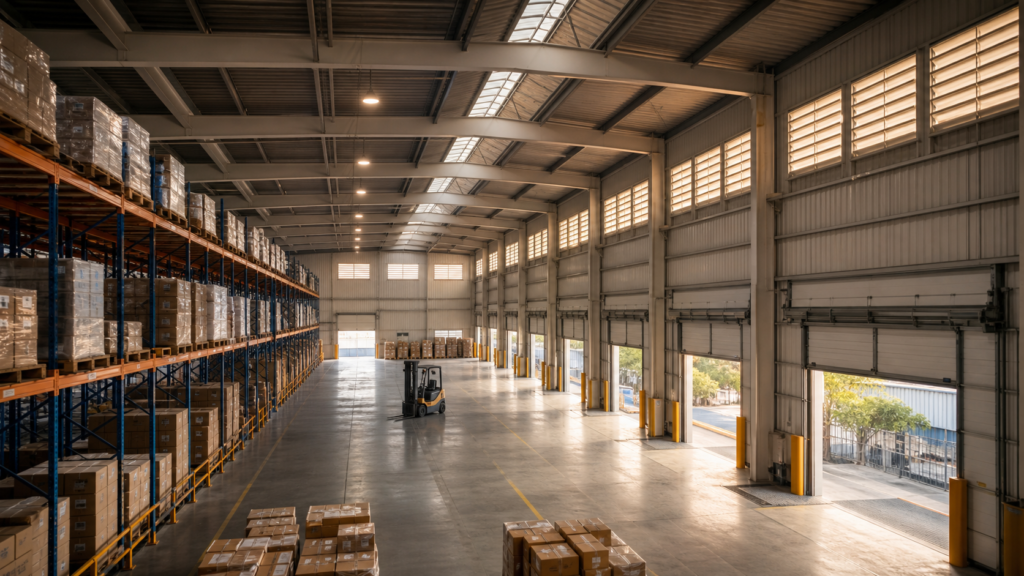
POPULA fan warehouse air quality planning for active logistics facilities
An active logistics warehouse changes through the day. Dock doors may remain open during deliveries, then close during sorting; temporary pallets can block wall louvers; and high racks can form long, sheltered corridors where air movement differs from the open floor. A practical ventilation review should therefore be completed during representative loading and storage conditions. It should consider dock-door use, racking arrangement, packing stations, battery-charging or maintenance locations, available make-up-air paths and the normal schedule of each ventilation zone.
Where general air exchange is required, axial fans are often useful for wall or roof exhaust with relatively low resistance. Centrifugal fans may be more appropriate when the warehouse needs a ducted route, filtration component or a system with higher pressure loss. Product selection should follow the required airflow, system resistance, installation location, sound expectation and maintenance access. A larger fan alone may not solve a problem if the inlet path is blocked or the exhaust point is located in a zone that bypasses the occupied area.
Teams can also document basic observations before making changes: stuffy or hot locations, door and louver positions, visible dust accumulation, fan operating status, rack changes, vehicle routes and the periods when complaints occur. Where air contaminants or employee exposure are a concern, measurements and control design should be completed by qualified professionals using the relevant local requirements. This distinguishes a responsible ventilation plan from a simple equipment purchase.
From open doors to a controlled airflow path
Open loading doors can provide useful air entry, but they are not automatically a dependable ventilation strategy. Wind direction, weather, dock layout and door schedules can change the result from hour to hour. A more stable approach combines deliberate make-up-air points with appropriately located exhaust points, then checks whether air is actually reaching the areas that need it. Rack ends, enclosed offices, packaging zones and distant corners may need separate attention rather than being treated as part of one large, uniform space.
Routine maintenance is equally important. Facility teams should inspect fan guards, motors, belts or couplings where applicable, vibration, electrical controls, louvers, roof openings and discharge areas. Storage should not obstruct intake or exhaust points. Any change in the warehouse process—such as different vehicle types, a new charging area, modified racking or altered dock operation—should trigger a review of whether the original airflow plan is still suitable.
Penyelesaian pengudaraan perindustrian POPULA can support logistics and industrial customers with fan application discussion, general ventilation fan selection and layout-oriented planning for warehouse air paths. A POPULA fan warehouse air quality review brings airflow, installation space, maintenance access and day-to-day operations into the same conversation. The goal is a practical system that can be understood, checked and adjusted as the warehouse changes over time.