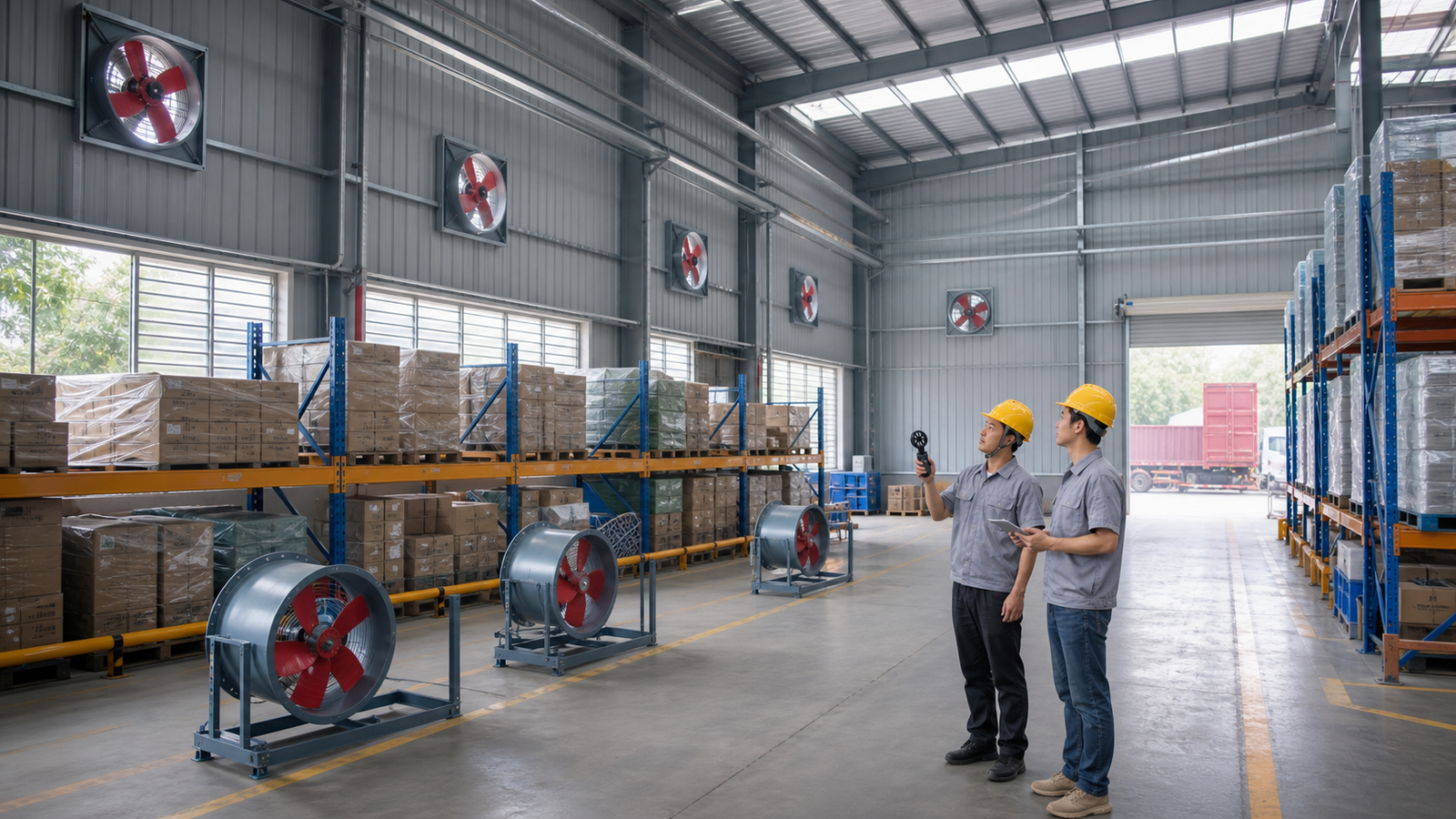

POPULA fan warehouse ventilation project planning began with a common high-temperature storage problem: the warehouse had tall pallet racks, frequent loading-door operation and weak air movement in the middle aisles. During hot weather, warm air accumulated below the metal roof and the existing small wall fans could not form a clear exhaust path. POPULA reviewed the site as a ventilation layout problem rather than a single-equipment replacement, and recommended using multiple SF(B) axial fans to discharge hot upper air, support aisle airflow and create a more stable air-exchange route for daily warehouse operation.

POPULA fan warehouse ventilation project application scenario
This application is suitable for high-bay warehouses, logistics storage areas, packaging warehouses and light-industrial stock zones where hot air builds up near the roof or workers stay for long periods in picking and loading areas. In this type of building, natural ventilation through doors is usually unstable because airflow changes with wind direction, door opening time and shelf layout. The ventilation system therefore needs planned exhaust points and controlled air movement instead of relying only on open doors.
The SF(B) axial fan was selected as the core product family for this case because the application required large air volume with a relatively simple installation method. According to the product information supplied for this project, the SF(B) series uses a twisted blade design and a flanged cylindrical casing, with models covering different airflow levels for workshop and warehouse air transport. The application condition was normal air ventilation; the solution was not designed for flammable, explosive or corrosive gases, and the handled air temperature should remain within the product’s stated operating limit.
Why this SF(B) axial fan product was selected
The warehouse did not require a complex ducted exhaust system for every aisle. Its main need was to remove upper hot air and guide fresh air through usable working zones. For this reason, POPULA chose the SF(B) axial fan concept over a heavier pressure-focused fan. Axial fans are practical when the priority is moving a larger volume of air through wall openings, short ducts or direct ventilation positions with moderate resistance.
Another reason was maintainability. Warehouses often prefer equipment that can be inspected without stopping a large production process. The SF(B) structure is straightforward: circular casing, axial impeller, motor assembly and mounting base or wall installation. This makes it easier for the maintenance team to check fasteners, guards, wiring and blade condition during routine inspection. The model range also allows the engineer to match different fan sizes to different zones instead of using one oversized fan for the whole building.
How the ventilation layout solved the warehouse airflow problem
The layout used two coordinated directions. First, larger SF(B) axial fans were arranged at high wall positions to exhaust hot air collected near the roof and upper rack area. Second, additional fans were placed along the main aisle and loading-side zones to push air through areas where workers and forklifts operate. This avoided a common mistake in warehouse ventilation: placing a fan where it creates local wind but does not connect to a complete airflow path.
POPULA also considered shelf obstruction, door position and service access. Fans were not placed directly behind tall goods or in locations where pallets could block the discharge side. The installation kept clear space around each unit for maintenance and avoided unsafe temporary wiring. In a warehouse project like this, the practical value comes from the whole layout: exhaust points, inlet air, aisle direction and equipment access must work together.