

กฎระเบียบด้านการออกแบบเชิงนิเวศน์สำหรับพัดลมอุตสาหกรรมของสหภาพยุโรปจะมีผลบังคับใช้ในเดือนกรกฎาคม 2026: ผู้ซื้อจากต่างประเทศควรเตรียมตัวอย่างไรบ้าง
EU industrial fan ecodesign rules are entering an important new phase. From 24 July 2026, Commission Regulation (EU) 2024/1834 will replace the earlier Regulation (EU) No 327/2011 for fans driven by motors with electrical input power from 125 W to 500 kW. For manufacturers, OEMs, engineering contractors and international buyers, the change puts greater emphasis on verified efficiency, clearly defined fan boundaries, product information and repairability.
The timing matters for projects now moving from specification to procurement. A fan selected only by diameter, motor power or a single catalogue airflow figure may not provide enough information for an EU-bound machine or ventilation system. Buyers need to understand what fan configuration is being assessed, where the declared performance point comes from, and which documents will be available with the equipment.
According to the European Commission industrial fan policy page, the updated regulation introduces stricter performance requirements and new provisions concerning repairability and fan performance at different loads and speeds. Eurovent and AMCA have also published the 2026 recommendation Quality Criteria for Fans and Fan Units, covering efficiency, acoustics, vibration, testing and mechanical design considerations.
Why the 2026 Ecodesign Change Matters Beyond Europe
The regulation is European, but its influence extends through international equipment supply chains. Industrial fans are frequently incorporated into air-handling equipment, process machinery, cooling packages, dust-control systems and factory ventilation assemblies that may be designed in one country, manufactured in another and installed in the EU.
This means an overseas buyer may need more than a compliant motor or a general efficiency statement. The supplied fan configuration, drive arrangement, impeller, motor and other components must be considered within the applicable regulatory system boundary. Project teams should identify early whether the fan is being supplied as an individual product, incorporated into another product, or configured for a special application that may be treated differently under the regulation.
POPULA industrial fan solutions are selected around the actual operating duty rather than diameter alone. For EU-related enquiries, customers should state the destination market and intended integration method at the beginning of the technical discussion so that efficiency data, motor information and documentation expectations can be reviewed before production.
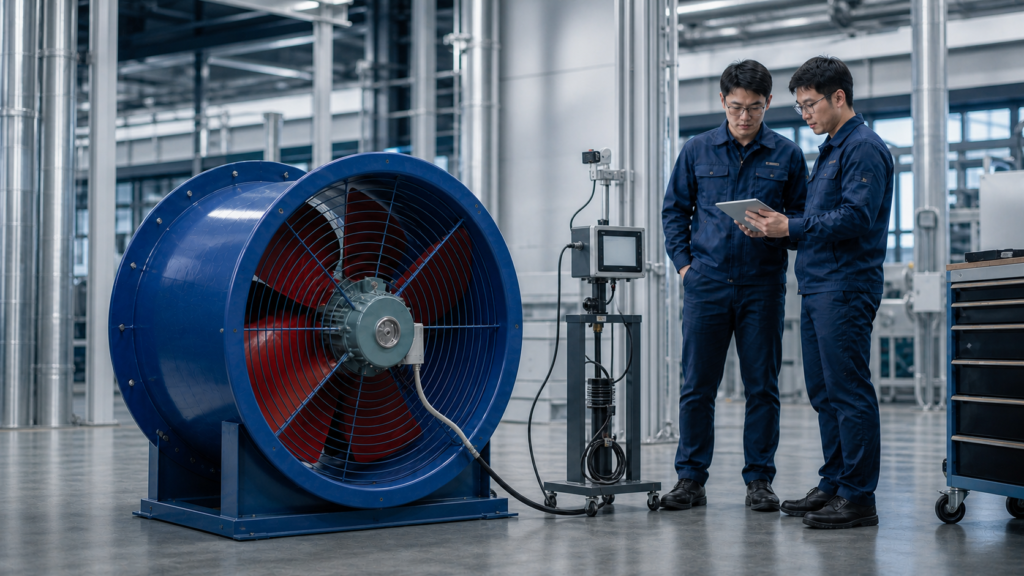
Efficiency Must Be Evaluated at a Defined Operating Point
One of the practical lessons behind the new requirements is that fan efficiency cannot be judged reliably from a single isolated component or an undefined maximum airflow value. Useful evaluation begins with a duty point: required airflow, static or total pressure, air density, operating temperature, fan speed and electrical input.
The installation also matters. Restricted inlets, abrupt transitions, poorly arranged bends, leaking ducts, dirty filters and incorrect outlet conditions can move the real operating point away from the design assumption. Even an efficient fan can perform poorly when it is installed in a system with excessive resistance or unstable airflow conditions.
For procurement teams, the following information should be requested and compared consistently:
- fan type, size and complete supplied configuration;
- rated airflow and pressure at the required duty point;
- fan speed, motor input and electrical supply;
- declared efficiency and the test or calculation basis;
- performance curves covering the expected operating range;
- sound data where acoustics are part of the specification;
- materials, coating and temperature limitations;
- documentation identifying the tested or evaluated fan boundary.
Part-Load Performance Is Becoming More Visible
Many industrial ventilation systems do not operate at one fixed duty throughout their service life. Production lines change, filters load, dampers move and variable-frequency drives reduce fan speed during periods of lower demand. The updated regulatory direction places more attention on how fans perform at different loads and speeds, making system control strategy increasingly relevant.
A variable-speed drive can reduce energy use when airflow demand changes, but only if the fan, motor, control logic and minimum operating conditions are selected as one system. Running at lower speed does not automatically solve poor sizing, unstable operation or an inefficient duct layout. Buyers should ask whether the selected fan remains within an appropriate operating region across the intended control range.
Repairability and Product Information Join the Buying Checklist
Efficiency at commissioning is only one part of lifecycle performance. A fan that is difficult to inspect, clean or repair may gradually lose airflow and consume more energy as contamination, wear or misalignment develops. The new framework adds repairability-related requirements and expands the importance of product information.
Engineering teams should therefore review access to the impeller, motor, bearings, belts, guards and removable panels where applicable. They should also confirm how critical components are identified and what maintenance information will accompany the equipment. These details are especially important for dusty factories, kitchen extraction, process exhaust and humid or corrosive environments.
What Buyers Should Send Before Requesting a Quotation
A complete enquiry helps the manufacturer determine whether a standard fan is suitable or whether the project requires a different motor, impeller, material, coating, drive arrangement or control method. For projects connected with the European market, buyers should provide:
- destination country and required regulatory framework;
- equipment type and whether the fan will be sold separately or integrated;
- airflow and pressure duty, including normal and maximum conditions;
- air temperature, density, humidity, dust and corrosion information;
- voltage, frequency, phase and control requirements;
- expected operating hours and part-load profile;
- installation drawings showing inlet, outlet and duct conditions;
- required efficiency, acoustic, test and technical documentation;
- maintenance access and spare-parts expectations.
Where the final system resistance is not yet available, buyers should avoid treating preliminary fan data as a released selection. A provisional comparison can identify suitable product families, but the operating point should be confirmed against an approved system calculation and the manufacturer’s performance information before an order is finalized.
A Practical Preparation Plan for July 2026
Companies sourcing fans for EU-bound equipment should use the weeks before 24 July 2026 to review active specifications and supplier documentation. The first step is to identify which projects fall within the applicable scope. The second is to check whether quoted performance refers to the complete fan configuration and the correct duty point. The third is to confirm what efficiency, repairability and product information will be supplied.
Project teams should also distinguish legal compliance from good system engineering. A compliant product can still be incorrectly sized or poorly installed, while a technically capable fan may still require additional documentation for a particular market. Compliance review, fan selection and system design need to move together.
POPULA Supports Application-Based Industrial Fan Selection
POPULA works with overseas buyers, OEMs and engineering contractors on axial, centrifugal, mixed-flow and specialized exhaust fan applications. Support begins with the required duty point and operating environment, followed by review of the fan structure, motor, materials, control method, installation constraints and destination-market documentation.
For an EU-related industrial fan enquiry, customers can send the project specification, airflow and pressure requirement, electrical supply, operating profile, installation drawing and documentation list. Early technical coordination gives both buyer and manufacturer time to resolve missing information before production, helping reduce selection risk as the 2026 ecodesign requirements take effect.
This article provides a general procurement overview and does not constitute legal or conformity-assessment advice. Project teams should review the current official regulation and obtain qualified compliance guidance for the specific product and application.