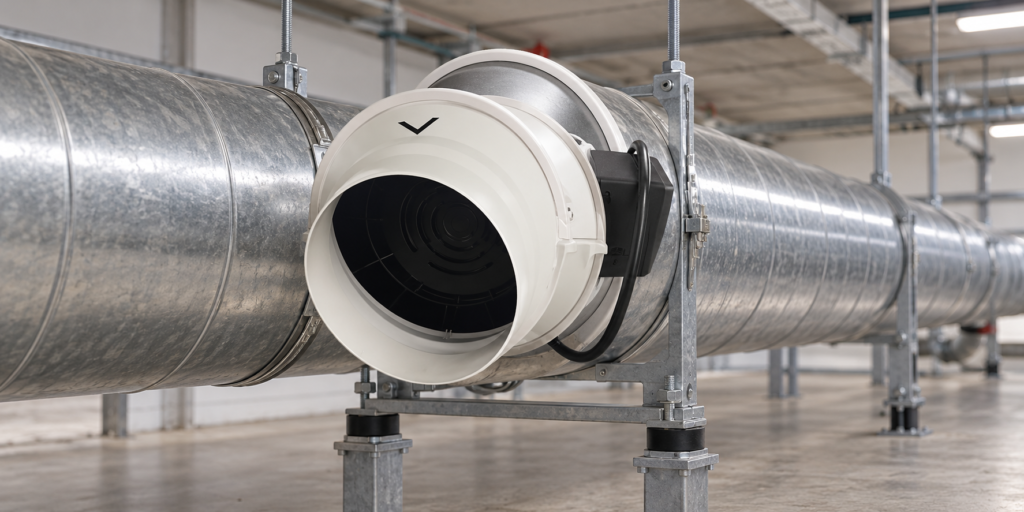

Mixed-Flow Fans for Ducted Ventilation: A Practical Specification Guide
A mixed-flow fan moves air through an impeller along a path that combines axial and radial movement. That describes the fan type, but it does not by itself tell you whether a particular model will meet a project’s airflow, pressure, noise, or space requirements. For a ducted application, specify the operating duty and check the exact model documentation before installation.
This guide outlines the information to gather when evaluating a mixed-flow fan for a duct route. For a product example, see the Quạt thông gió ống dẫn dòng hỗn hợp dòng JD and the site’s Dòng sản phẩm Fresh Air. Product-specific performance and installation details must come from the applicable model documents.
What is a mixed-flow fan?
A mixed-flow fan uses an impeller with flow characteristics between axial and centrifugal types: air moves both along and away from the impeller axis. In an inline mixed-flow fan, air enters axially and the housing guides the flow back toward an axial discharge. The exact construction varies by product, so the term “mixed flow” should not be treated as a performance rating.
1. Define the required operating point
Start with the airflow required at the system’s intended operating condition and the pressure the fan must overcome. Record the pressure basis and units used in the project documents; static pressure and total pressure are not interchangeable. Include relevant air conditions and note whether the fan handles clean air, warm air, moisture, dust, or another specified medium. Do not select by motor power or fan type alone.
Ask for performance data for the exact model and configuration. Locate the stated duty point on the manufacturer’s fan curve or selection sheet and verify that the listed airflow and pressure match the project requirement. If the duty point, speed, or configuration is unclear, request clarification before ordering.
2. Map the complete duct route
List the duct sections and components that affect resistance, including bends, transitions, branches, dampers, filters, grilles, and discharge terminals. Use the project design or a qualified ventilation engineer’s calculation to establish system pressure loss. The fan must be evaluated against the whole route, not only the straight duct diameter or the free-air airflow shown in a brochure.
Check how the fan connects to adjoining ducts and whether the inlet and outlet conditions follow the model’s installation instructions. Space restrictions, nearby elbows, abrupt area changes, and obstructions can affect the installed system. Confirm the connection dimensions and layout from approved drawings rather than assuming every mixed-flow product uses the same arrangement.
3. Confirm installation and service access
Before fixing the ductwork, verify the fan’s physical dimensions, mounting points, support method, required clearances, airflow direction, and any permitted installation orientations in the product manual. Make sure the motor, wiring connection, and service components remain accessible after ceilings or guards are installed.
Plan for safe isolation and the maintenance tasks specified by the manufacturer. A design that leaves no practical access can make inspection or cleaning difficult. Do not remove the fan from a sealed duct route or alter its mounting arrangement unless the instructions for that model allow it.
4. Check the motor and controls
Match the motor’s voltage, phase, frequency, current, and rated speed to the site supply and the equipment schedule. If variable-speed control is proposed, confirm compatibility with the exact motor and fan, the approved operating range, and any required protections. Do not assume that every mixed-flow fan can be controlled with a variable-frequency drive or operated safely at any speed.
Review sound requirements and any vibration or support details using model-specific information. “Mixed flow” alone does not guarantee a particular sound level or vibration result; installation and operating conditions matter.
5. Document commissioning results
At commissioning, record the model identification, control settings, measurement method, operating condition, and measured airflow or pressure values required by the project. Compare the results with the approved duty point and investigate meaningful differences. Check for incorrect rotation where applicable, closed dampers, blocked filters, duct leakage, or installation changes before assuming the fan itself is undersized.
Questions to resolve before specifying
- What airflow and pressure are required at the actual operating point?
- Which pressure definition, units, and air conditions are used?
- What resistance comes from the entire duct route and its components?
- Does the selected model’s curve cover the required duty?
- Are mounting, connections, orientation, clearances, controls, and service access confirmed in the model documents?
Frequently asked questions
Does “mixed flow” guarantee more pressure or less noise?
No. It describes the airflow path through the impeller. Check the selected model’s performance and sound data for the required operating condition.
Can a mixed-flow fan be installed in any orientation?
Not automatically. Follow the installation instructions for the exact model and confirm orientation, support, drainage where relevant, and access before building the duct route.
Can mixed-flow fans be installed in series or parallel?
Some products or systems may be designed for staged arrangements, but suitability depends on the model, controls, system design, and manufacturer’s instructions. Obtain project-specific confirmation before combining fans.
For assistance identifying a suitable product, use the model data and duct duty when contacting the supplier. A product category name is a starting point; the selected fan still needs to match the documented system requirement.