

POPULA tăng cường hỗ trợ hệ thống thông gió công nghiệp trong điều kiện khí hậu nóng ở châu Á và Trung Đông.
Hot-climate industrial ventilation is becoming a more important planning priority for factories and engineering projects across the Middle East, South Asia, and Southeast Asia. To support buyers working in these demanding regions, PHỔ BIẾN is strengthening its application-focused support for industrial fan selection, project coordination, and export procurement.
High ambient temperatures are only one part of the challenge. Many facilities must also manage humidity, dust, corrosive air, continuous production schedules, fluctuating process loads, and limited maintenance windows. A reliable ventilation plan therefore requires more than choosing a fan from a catalogue. It starts with understanding the operating environment and matching the equipment to the actual duty point.
Hot-Climate Industrial Ventilation Requires Application-Specific Planning
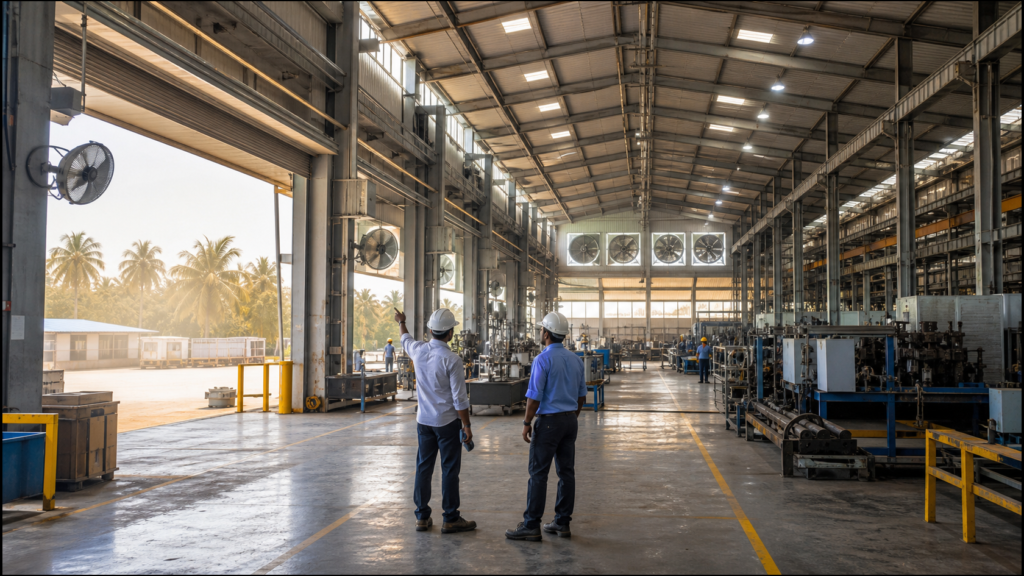
Factories in hot regions can experience heat from solar gain, machinery, furnaces, motors, lighting, and densely occupied production areas. When warm air remains trapped beneath a high roof or around process equipment, workers may face uncomfortable conditions while electrical and mechanical systems operate under additional thermal stress.
The correct response depends on the building and the process. A large open workshop may need high-volume air exchange using wall-mounted or roof exhaust fans. A production line generating fumes or dust may require source capture and a centrifugal fan capable of overcoming duct, hood, filter, or collector resistance. Warehouses, utility rooms, paint areas, food-processing plants, and metalworking facilities can each require a different airflow strategy.
PHỔ BIẾN works with buyers to review practical project information before recommending a fan configuration. Useful inputs include workshop dimensions, required airflow, estimated static pressure, ambient and air-stream temperatures, humidity, dust characteristics, operating hours, installation position, available power supply, noise expectations, and destination-market requirements.
Different Regions Present Different Ventilation Conditions
Industrial projects across the Middle East, South Asia, and Southeast Asia share the need for dependable air movement, but their site conditions are not identical.
- Middle East: projects may need to account for very high outdoor temperatures, airborne sand and dust, exposed rooftop installations, and long daily operating hours.
- South Asia: factories often need to manage seasonal heat, monsoon humidity, dense production layouts, and changing ventilation demand across different shifts.
- Southeast Asia: year-round humidity, warm air, moisture, coastal exposure, and process-generated heat can influence material selection, motor protection, and maintenance planning.
These differences affect decisions such as fan type, motor specification, drive arrangement, protective finish, access for cleaning, weather protection, and control method. Buyers can reduce specification risk by sharing real site conditions at the beginning of the enquiry rather than relying only on fan diameter or motor power.
Energy Use Must Be Evaluated at the System Level
In facilities where ventilation operates for extended hours, electricity consumption becomes a major lifecycle consideration. Energy performance depends not only on the motor but also on fan sizing, impeller efficiency, duct resistance, inlet and outlet conditions, control strategy, and maintenance.
An oversized fan running against a heavily throttled damper can waste energy. An undersized fan may fail to provide the required air change and may run continuously without solving the original problem. Poorly arranged bends, restricted inlets, dirty filters, and leaking ducts can further reduce useful airflow.
For applications with changing production or heat loads, variable-speed control may help match airflow to actual demand. However, the fan, motor, drive, control logic, and minimum safe operating speed should be considered as one system. PHỔ BIẾN can support these discussions by reviewing the intended duty and helping project teams compare suitable axial, centrifugal, mixed-flow, cabinet, or specialized exhaust solutions.
Procurement Support Extends Beyond Fan Selection
International projects involve more than technical performance. Procurement teams also need clear documentation, suitable packaging, manageable lead times, and accurate coordination between the fan manufacturer, contractor, consultant, and facility owner.
To improve enquiry efficiency, buyers should prepare the following information where available:
- airflow and static-pressure requirements;
- application and air-stream description;
- temperature, humidity, dust, and corrosion conditions;
- installation drawings or site photographs;
- voltage, frequency, and motor requirements;
- indoor, outdoor, rooftop, wall, or duct installation details;
- quantity, delivery destination, and project schedule;
- required certificates, test documents, or inspection arrangements.
Even when complete engineering data is not yet available, a workshop layout and a clear description of the ventilation problem can provide a useful starting point. Early technical communication helps identify missing information before production and reduces the risk of ordering equipment that does not match the system.
Maintainability Matters in Demanding Factory Environments
Hot, humid, or dusty conditions can accelerate contamination and wear if equipment is difficult to inspect. Maintenance access should therefore be considered during layout design. Project teams should allow safe access to the impeller, bearings, belts, motor, guards, flexible connections, filters, and dampers where applicable.
Routine inspection of vibration, bearing condition, motor current, fasteners, coatings, belt alignment, and impeller cleanliness helps protect performance. In dusty applications, deposits on the blades can disturb balance and reduce airflow. In humid or coastal locations, corrosion protection and drainage details may be equally important.
A maintainable system supports more predictable operation and makes it easier for factory teams to address small issues before they become unplanned downtime.
A Practical Regional Focus for Long-Term Projects
By strengthening support for hot-climate projects, PHỔ BIẾN aims to help overseas buyers move from basic product comparison to application-based selection. The focus is practical: understand the environment, define the duty point, select the correct fan structure, coordinate the project details, and plan for efficient operation and maintenance.
Procurement managers, engineering contractors, and factory operators in the Middle East, South Asia, and Southeast Asia can contact PHỔ BIẾN with project drawings, site conditions, or ventilation challenges. The engineering team can then review the available information and recommend an appropriate next step for factory exhaust, cooling, air supply, dust extraction, smoke control, or process ventilation requirements.