

Factory Ventilation Upgrades Become a Priority for Industrial Facilities in Hot-Climate Markets
Factory ventilation upgrades are becoming a higher priority for industrial facilities in hot-climate markets, especially where production buildings face long operating hours, high roof temperatures, dense equipment layouts, and limited natural airflow. For many factories, a reliable ventilation system is no longer only a comfort improvement. It is part of daily production stability, worker environment management, and equipment heat control.
As an 工业风扇 manufacturer, 波普拉 is seeing more customers review existing airflow conditions before peak hot seasons. These projects often involve axial ventilation fans, centrifugal fans, roof exhaust fans, fresh air systems, and local exhaust equipment selected according to workshop layout and pressure requirements.
Why Factories Are Reviewing Ventilation Earlier
In many industrial buildings, indoor heat does not come from one source. Metal roofs, outdoor temperature, production machines, motors, lighting, people, and enclosed layouts can all increase the heat load. When air movement is weak, hot air gathers near the roof and remains inside the workshop for a long time.
This can make the working environment uncomfortable and reduce the effect of local exhaust points. In some factories, poor air replacement also causes negative pressure problems or uneven airflow between different production zones. Because of these issues, more plant managers are checking fan performance, airflow direction, and fresh air supply before the hottest period of the year.
Common Signs That a Workshop Needs an Upgrade
A factory ventilation upgrade is usually needed when the existing system cannot remove heat or replace air effectively. The problem may not always be the fan itself. Sometimes the fan is installed in the wrong position, the airflow path is blocked, or the system lacks enough fresh air intake.
Typical Problems Found on Site
- Hot air stays under the roof after production starts
- Workers feel strong temperature differences between workshop areas
- Existing exhaust fans run continuously but airflow remains weak
- Fresh air enters through uncontrolled openings instead of planned inlets
- Ducted systems lose performance because of elbows, filters, or resistance
- Equipment rooms become hotter than the surrounding production area
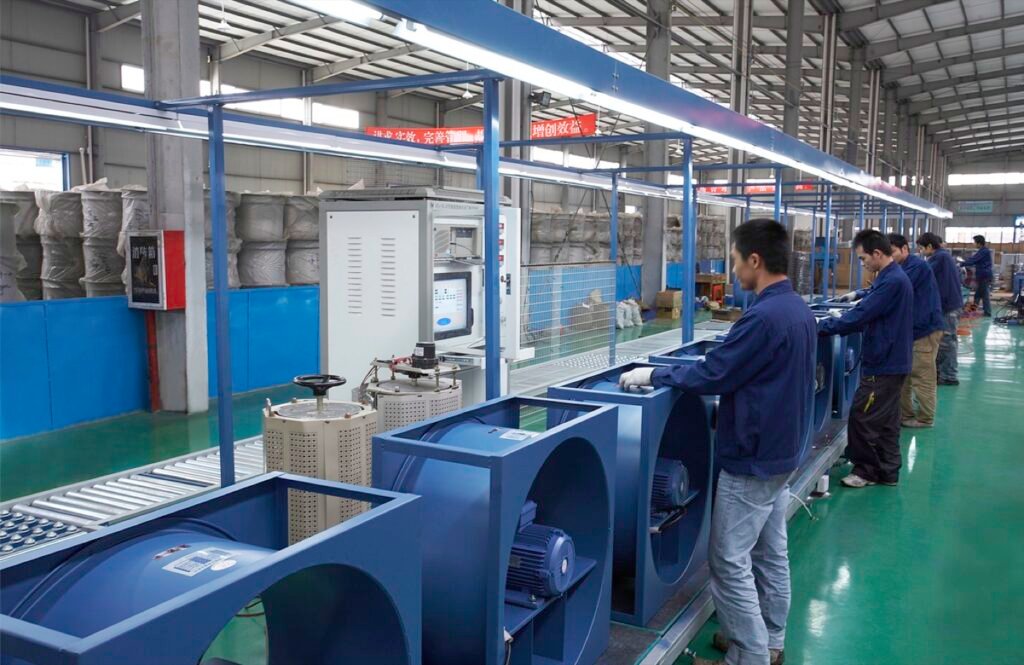
Axial Fans for Large Airflow Exchange
Axial fans are commonly used for factory ventilation because they can move large air volumes in low-resistance conditions. They are suitable for wall exhaust, roof exhaust, short duct ventilation, and general air exchange in open workshops.
For buildings that need direct heat removal, wall-mounted axial fans can help discharge hot indoor air and guide fresh air across the production area. When axial fans are arranged with proper inlet positions, the whole workshop can achieve a clearer airflow path instead of isolated air movement around each fan.
Centrifugal Fans for Ducted and Local Exhaust
Centrifugal fans are often selected when the system includes ducts, elbows, filters, silencers, or local exhaust hoods. Compared with axial fans, centrifugal fans can provide higher pressure and more stable airflow under resistance.
In factory ventilation upgrades, centrifugal fans are useful for removing hot air from equipment zones, process areas, dust collection points, and HVAC exhaust systems. They are also suitable when air must be moved through a longer duct route before discharge.
Fresh Air Supply Is Just as Important as Exhaust
Many workshops focus on exhaust fans first, but exhaust alone cannot create balanced ventilation. If a factory removes a large amount of air without planned replacement air, the system may pull air from doors, gaps, or dusty areas. This can reduce airflow control and may bring unwanted heat or contaminants into the workspace.
A better factory ventilation plan usually combines exhaust fans with fresh air supply. Fresh air inlets, louvers, supply fans, or air handling equipment can help keep the system balanced and improve the comfort of occupied production areas.
How POPULA Supports Factory Ventilation Projects
波普拉 supports industrial customers, contractors, and distributors with fan selection for factories, warehouses, commercial buildings, and mechanical ventilation projects. The selection process usually starts with the real operating conditions instead of only the fan size.
For each project, POPULA can review airflow volume, static pressure, duct layout, installation position, voltage, working temperature, noise requirements, and maintenance access. This helps customers choose a suitable ventilation fan type for each zone of the building.
Information Needed Before Fan Selection
Before a factory ventilation upgrade, customers should prepare basic project information. Accurate data makes it easier to recommend the right fan model and avoid oversizing or undersizing.
- Workshop size and roof height
- Required airflow volume or target air changes
- Static pressure or estimated duct resistance
- Heat sources and equipment layout
- Air medium, dust, humidity, oil mist, or temperature conditions
- Installation location and available space
- Power supply, voltage, and frequency
- Noise control and maintenance requirements
Practical Ventilation Planning for Hot Markets
Hot-climate markets often require a practical balance between airflow performance, installation cost, energy use, and maintenance. A single large fan may not solve every problem if the airflow path is poorly designed. In many workshops, several fan types working together can produce better results.
For example, axial fans may handle general workshop exhaust, centrifugal fans may support local ducted extraction, and fresh air supply may improve air replacement in occupied zones. This combined approach gives the system more flexibility and helps each fan work in the area where it performs best.
FAQ
When should a factory consider a ventilation upgrade?
A factory should consider a ventilation upgrade when indoor heat builds up quickly, airflow is uneven, existing fans cannot remove hot air effectively, or fresh air supply is not balanced with exhaust volume.
Are axial fans enough for factory ventilation?
Axial fans are suitable for large airflow and low-resistance ventilation, but ducted areas or local exhaust points may require centrifugal fans with higher pressure.
Why does fresh air supply matter?
Fresh air supply helps replace exhausted air and keeps the ventilation system balanced. Without enough replacement air, exhaust performance may drop and uncontrolled air may enter the building.
Can POPULA support overseas factory ventilation projects?
Yes. POPULA can support overseas projects with industrial fan selection, production, quality control, and export-ready ventilation solutions based on project requirements.
Contact POPULA for Factory Ventilation Fans
If your facility is preparing a factory ventilation upgrade, contact 波普拉 with your airflow, pressure, workshop layout, and working condition requirements. Our team can recommend axial fans, centrifugal fans, roof exhaust fans, or a combined ventilation solution for your project.