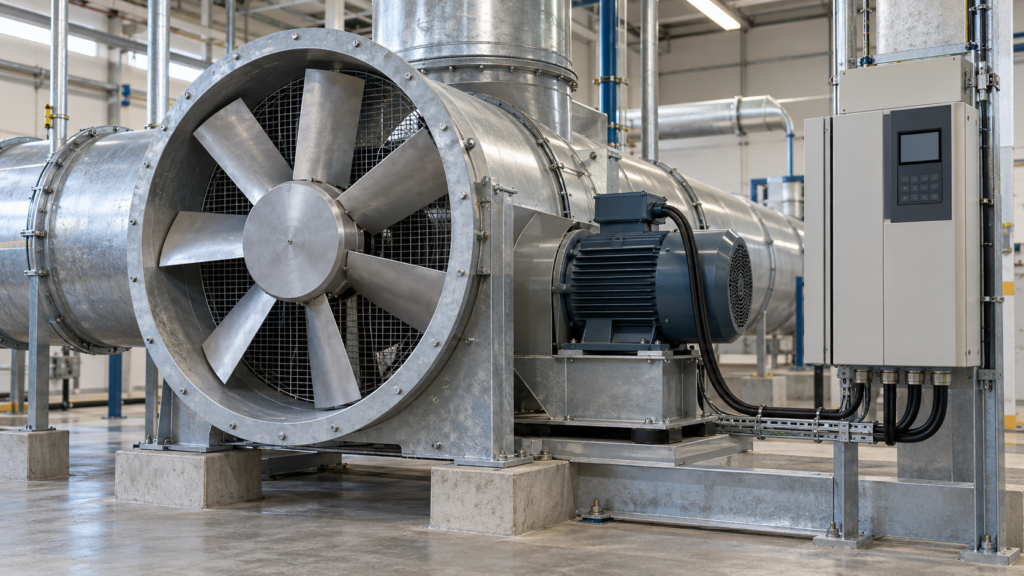

Axial Fan Variable-Speed Control: Compatibility Checks Before Adding a VFD
Axial fan variable speed control can help respond to changing ventilation demand, but a variable frequency drive (VFD) should not be added by assumption. Fan, motor, drive, controls, and the air system must be checked together before the operating speed is changed.
This guide outlines the main compatibility questions facility teams should resolve with the fan manufacturer and a qualified electrical or controls professional. POPULA’s axial fan range includes several designs; the approved operating limits depend on the specific model and motor configuration.
When can variable-speed control be useful?
A VFD changes the speed of a compatible AC motor, allowing a fan system to adjust its output when ventilation requirements vary over time. The U.S. Department of Energy’s Better Plants program lists variable-speed control as a fan-system measure to consider in place of modulating dampers or inlet guide vanes for airflow control. That is general guidance, not a guarantee that every fan can use a VFD or that every installation will save energy.
Variable-speed control is most relevant when a process has genuinely changing airflow needs and the fan can safely operate across the proposed speed range. If the fan normally runs at one steady condition, the added control equipment may not provide a practical benefit. A system assessment should establish the operating need before equipment is specified.
1. Confirm the exact motor and electrical supply
Start with the motor nameplate and the fan supplier’s documentation. Confirm the motor type, rated voltage, frequency, current, power, insulation and temperature limits, and whether the motor is approved for inverter duty or operation with a VFD. Do not assume that motors with the same power rating have the same drive compatibility.
The drive must be selected and configured for the actual motor and supply. Ask the supplier to confirm any limits on cable length, switching frequency, cooling, overload protection, and minimum operating speed. Follow the motor and drive manufacturers’ instructions and applicable local electrical requirements.
2. Check the fan’s permitted speed range
A motor’s ability to turn more slowly does not establish that the fan assembly can safely run at any chosen speed. Confirm the minimum and maximum permitted fan speeds for the exact axial fan model, including restrictions related to impeller loading, structural strength, bearings, drive arrangement, and vibration.
Use the manufacturer’s performance data to check whether the proposed speed range can meet the required airflow and pressure. The fan must remain suitable for the system at each intended operating point. Do not extrapolate beyond published limits or use a VFD as a substitute for correct fan selection.
3. Verify motor cooling and thermal protection
At lower speeds, some motors may receive less cooling from their own fan. The effect depends on motor design, load, enclosure, and duty cycle. Confirm that motor temperature remains within its rated limits throughout the planned operating range, especially during continuous operation or frequent speed changes.
Review overload, over-temperature, short-circuit, and grounding protection with the responsible electrical professional. The required protective devices and settings depend on the actual motor, drive, and installation.
4. Review vibration, resonance, and operating noise
Changing speed can move a fan through operating conditions that produce unwanted vibration or noise. Ask the manufacturer or commissioning engineer whether any speed bands should be avoided, and establish how vibration will be checked during commissioning. Do not disable protective trips or keep operating a fan that shows abnormal vibration.
5. Coordinate the drive with the ventilation controls
Decide how speed will be commanded and monitored: for example, by a process signal, a pressure or airflow sensor, or a building control system. Confirm the signal type, safe operating limits, alarm response, start/stop sequence, and what happens if the sensor or communication signal fails.
Record the minimum and maximum setpoints and document who is authorized to change them. Commissioning should verify the actual airflow or pressure at representative operating points rather than relying only on a drive display.
6. Keep life-safety fan systems under approved control
Fire and smoke exhaust systems have a separate life-safety purpose. Do not add a VFD, change a speed setpoint, or alter a control sequence on a fire or smoke exhaust fan unless the fan manufacturer, responsible design professional, and applicable authority confirm that the complete system remains compliant with the approved design and local requirements.
Pre-installation checklist
- Identify the fan model, motor nameplate data, and current control method.
- Define the required airflow or pressure at each planned operating condition.
- Obtain written confirmation of the allowable fan and motor speed range.
- Check motor cooling, duty cycle, protections, wiring, and drive compatibility.
- Review vibration or resonance restrictions and commissioning measurements.
- Confirm control signals, fail-safe behavior, alarms, and setpoint access.
- Keep smoke-control and other safety-critical systems on their approved sequences.
- Save the selected drive settings and commissioning results with the fan records.
Questions to ask before specifying a VFD
Before purchase or retrofit, share the fan model, motor nameplate, supply details, operating schedule, current and required airflow, system pressure, and control signals with the fan supplier. Ask which speeds are approved, what motor protection is required, and which checks are expected during commissioning.
For model information, see POPULA’s SF(G) axial fan page and the full axial fan series. Product specifications and speed-control compatibility must be confirmed for the exact configuration.
Frequently asked questions
Can any axial fan be connected to a VFD?
No. Compatibility depends on the motor, fan construction, approved speed range, cooling, electrical supply, and control requirements. Get model-specific confirmation before installation.
Will a VFD always reduce fan energy use?
No. The result depends on how much the airflow demand varies, the fan and system operating points, the control strategy, and the equipment configuration. Assess the complete system rather than assuming a fixed saving.
Can I use a VFD to reduce airflow instead of selecting a smaller fan?
Only if the fan and motor are approved for the intended operating range and the resulting airflow and pressure meet the process requirements. Confirm the operating points with the manufacturer.
Who should configure and commission the drive?
A qualified electrical or controls professional should configure the drive according to the motor and VFD documentation, applicable electrical rules, and the fan supplier’s limits. Measure system performance during commissioning.
Conclusion
Variable-speed operation can be a useful control option when an axial fan serves changing demand, but it requires model-specific checks. Confirm electrical compatibility, allowable speed, motor cooling, protection, vibration behavior, and controls before specifying or retrofitting a VFD. Then verify the system under its intended operating conditions.
Technical reference: U.S. Department of Energy, Better Plants — Fans.