

随着工厂面临越来越炎热的工作环境,POPULA风扇的隔热通风系统备受关注。
POPULA fan heat protection ventilation is gaining more attention as factories prepare for longer and hotter workdays. In early July 2026, European labor groups again called for stronger heat protection rules for workers during extreme summer conditions, while official workplace safety guidance continues to emphasize planning, training, water, rest, shade and engineering controls. For industrial sites, that discussion is not only about policy; it is also a reminder to review how indoor heat, stagnant air and poor exhaust routes are managed inside real production buildings.
Factory heat risk is often created by several factors at the same time: outdoor temperature, roof radiation, machine heat, ovens, compressors, dense production lines and limited fresh-air paths. When these conditions combine, workers may feel discomfort even if a few local fans are running. The problem is not simply whether air is moving, but whether hot air is being removed from the right places and whether fresh air can reach the areas where people actually work.
波普拉 sees more customers asking for practical ventilation reviews before the hottest part of the production season. A POPULA fan heat protection ventilation plan normally looks at heat source locations, roof or wall exhaust points, inlet air, fan capacity, operating schedule and maintenance condition. The goal is to support safer and more stable workshop conditions by creating a clearer airflow path, not by treating fans as a substitute for the full heat-prevention program required by each site.
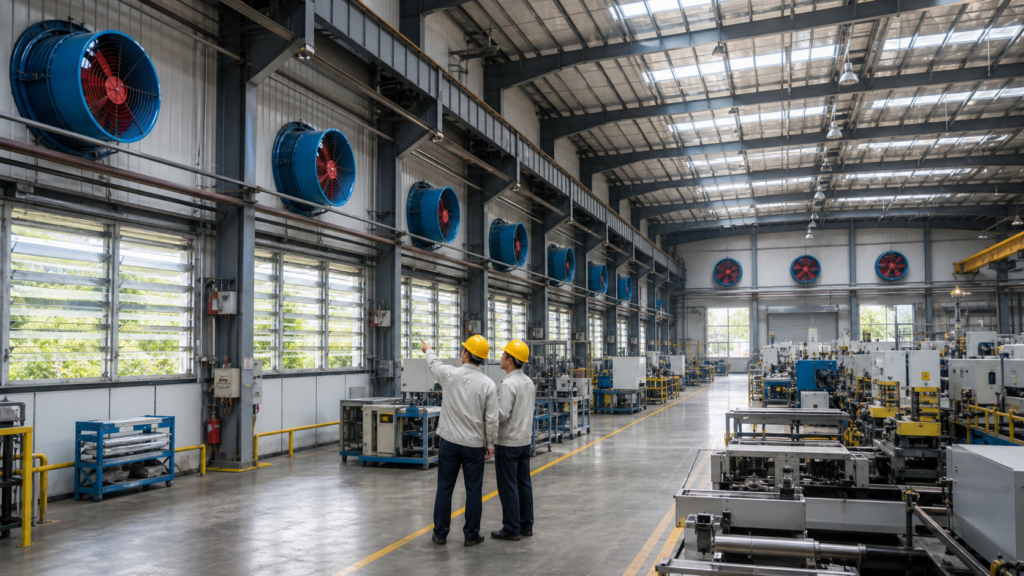
POPULA fan heat protection ventilation for industrial workshops
For many factories, the most urgent issue is not a lack of fans, but a lack of airflow structure. Portable fans may improve comfort near one workstation but can also push hot air from one zone to another. Exhaust fans may run continuously but fail to remove heat if the inlet path is blocked or if the exhaust point is placed too low. A useful ventilation review therefore starts with the building layout before moving to product selection.
Industrial fan selection should match the heat problem. Axial fans are often suitable where large airflow and lower resistance are needed, such as wall exhaust, roof exhaust or general workshop air exchange. Centrifugal fans may be better for ducted systems, filtration, process exhaust or routes with higher pressure loss. In some projects, the right solution is a combination of exhaust fans, fresh-air inlets, duct sections, louvers and controlled operating schedules.
POPULA recommends that factories document workshop dimensions, roof height, process heat sources, existing fan locations, inlet and outlet areas, duct resistance, noise expectations and available power supply before ordering new equipment. Photos, videos and simple temperature observations are also useful because they show where hot air collects and where workers spend the most time. This makes the ventilation plan more realistic than selecting a fan only by motor power or diameter.
How factories can prepare before peak heat periods
Before peak heat periods arrive, facility teams can check several practical points. Are exhaust fans clean and operating normally? Are guards, belts, bearings and wiring in good condition? Are air inlets blocked by materials, temporary partitions or storage racks? Are roof or wall openings positioned to remove the hottest air, or are they only moving air through an easy but ineffective route? These details often decide whether an industrial ventilation fan system performs as expected.
Operating strategy also matters. Some workshops need continuous air exchange because the process produces heat all day. Others can benefit from zone-based operation, temperature-triggered control or increased ventilation during peak production shifts. The safest approach is to combine ventilation with the site’s wider heat-prevention measures, including rest planning, drinking water, supervision and emergency response procedures where required. Fans support heat protection, but they should be part of a complete plan.
As workplace heat becomes a more visible topic in 2026, industrial customers are likely to review ventilation systems earlier and more carefully. POPULA fan heat protection ventilation can help factories identify whether existing fans should be cleaned, repositioned, controlled differently or replaced with models better suited to the airflow path. For new projects, POPULA can support fan selection and layout planning so that hot-air exhaust, fresh-air supply and maintenance access are considered together from the beginning.