

Solusi Ventilasi Garasi Parkir Bawah Tanah kanggo Zona Mati Aliran Udara
POPULA fan underground parking ventilation solution addresses a common large-space problem: a parking level may have main supply and exhaust equipment, yet air can remain stagnant around deep parking bays, ramps, turning zones and areas separated by columns. When air enters and leaves by the shortest route, it can bypass the corners that need it most. The answer is not simply adding more exhaust capacity; it is to create a deliberate air path from the fresh-air source, across the occupied parking level, toward the designated exhaust point.
This solution combines three roles. SF(G) reinforced axial wall fans provide mechanical supply air at an exterior wall or fresh-air shaft. PYD induction fans are distributed through the parking level to guide that fresh air across the space without a large internal duct network. DT cabinet centrifugal fans provide the central daily-exhaust function through the selected exhaust route. Together, these products support a more organised ventilation path than relying only on openings or a single extraction point.
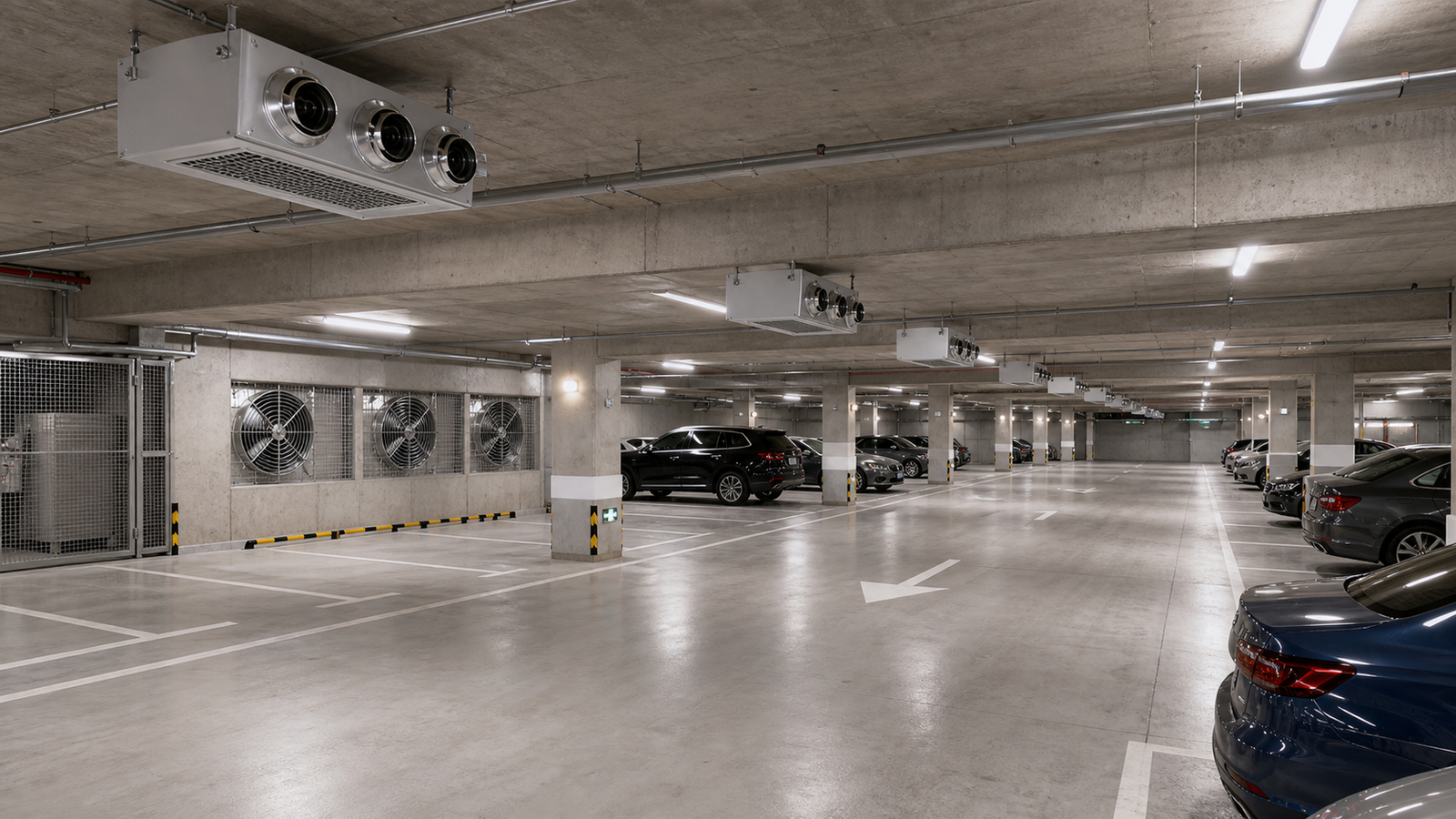
POPULA treats this as a daily mechanical ventilation solution for appropriate garage conditions. It is not a substitute for a separately engineered fire and smoke-control system, carbon-monoxide monitoring strategy, emergency operation sequence or any local code requirement that applies to the project.
POPULA fan underground parking ventilation solution: three roles in one airflow path
SF(G) reinforced axial wall fans are suitable for mechanical supply, general ventilation, pipe pressurisation, supply air, exhaust air and roof ventilation in industrial and building applications. For an underground parking level, a suitable SF(G) configuration can be positioned at the exterior wall or new-air shaft to introduce controllable outside air. Its blade design is intended to provide large airflow with relatively low noise and power consumption. The final wall opening, fan size, guard, weather protection, electrical supply and access arrangement must be matched to the actual construction conditions.
PYD induction fans work as part of a ductless jet-induction ventilation system. Rather than treating each parking bay as a separate duct branch, several compact PYD units can be suspended along the ceiling and arranged to direct air through the target zones. The supplied product information lists PYD120 at 120 W with 650 m³/h airflow and PYD180 at 180 W with 860 m³/h airflow, each with a 15 m/s outlet velocity. These values describe the product range; the number, spacing, orientation and control sequence must be determined from the parking layout, ceiling height, obstructions and required air-change calculation.
DT cabinet centrifugal fans provide the daily central-exhaust role. The series is designed for indoor ventilation applications in large buildings and is described as efficient, low-noise, compact and easy to maintain, with a handled-gas temperature not exceeding 80°C. The relevant DT model should be selected from the calculated exhaust airflow and static pressure, not from parking area alone. For the stated product range, verify the transported-air conditions, installation room, duct resistance, power supply, vibration isolation and maintenance access before final selection.
How to lay out supply, induction and exhaust equipment
Start by locating the fresh-air entry and the intended exhaust point. They should be separated enough to encourage airflow through the parking level rather than allowing a short circuit near the same wall. Next, identify the difficult zones: blind corners, long rows behind columns, ramp bottoms, low-ceiling areas and spaces screened by storage or service rooms. PYD induction fans can then be arranged in a sequence that carries supply air through these areas toward the exhaust route. The jet direction should be coordinated from one unit to the next; random orientation can create local turbulence without solving a dead zone.
Where the main supply or exhaust fan is connected to a shaft or duct, avoid unnecessary restrictions at louvers, grilles and transitions. Keep access clear for cleaning, inspection and repair. Ceiling-mounted induction fans should be suspended securely with sufficient clearance from lights, sprinklers, signs and vehicle routes, while allowing future maintenance. Controls can be grouped by zone so that operators can respond to different periods of use, but any local automatic-control or emergency operating requirement must be set by the project’s qualified designers and authorities.
Practical value for garage operators
For operators, the value is a ventilation system that is easier to understand and inspect: outside air enters at known points, induction units guide it through the parking level, and exhaust equipment removes it through a defined route. This can make routine checks more focused. Teams can inspect wall openings, fan guards, motors, vibration, suspended-unit brackets, electrical controls, grille cleanliness and the availability of the exhaust path instead of assuming that a running main fan means every parking bay is ventilated effectively.
Solusi ventilasi industri POPULA can support product application discussion, SF(G), PYD and DT fan selection, and layout-oriented planning for suitable underground parking ventilation projects. A robust POPULA fan underground parking ventilation solution is built from verified air quantity, resistance, air path, equipment spacing and maintenance requirements—not from a single fan model or a generic garage drawing.
